The Revenue Discipline Model
A practical framework for organisations that need greater clarity, consistency and confidence across complex enterprise revenue.
15-minute read · Download the complete RDM guide
Five disciplines for building predictable enterprise revenue
Why enterprise revenue becomes difficult to predict
A healthy-looking enterprise pipeline can create a strong sense of confidence, yet in many growing B2B businesses the opportunities can appear more established than they actually are. At first glance, there are credible opportunities, significant deal values, senior stakeholder meetings, demonstrations, proposals and commercial discussions. The forecast suggests there is revenue ahead.
Then leadership starts looking at the deals one by one. Who inside the customer is actually driving this? Has the case for change become strong enough? Are the right stakeholders aligned? What still needs to happen before a decision can be made? An opportunity may still have regular meetings, a strong relationship with a key contact and positive feedback. Yet it may have been sitting at the same point for weeks, with little evidence that the customer itself is moving any closer to a decision.
This gets to one of the central challenges in enterprise revenue:
The organisation often has much more visibility of its own sales activity than it has of the conditions shaping the customer’s decision.
Meetings, demonstrations, proposals, CRM stages and anticipated close dates are clearly visible. The internal work taking place inside the buying organisation is much harder to see: stakeholders aligning, priorities being challenged, risks being worked through, internal ownership developing and the buying group gradually building enough confidence to make a decision.
As that uncertainty carries through the forecast, opportunities move from one quarter to the next, late-stage deals lose momentum and pipeline coverage can appear stronger than conversion. Leadership therefore needs a clearer view of the conditions that make an enterprise opportunity genuinely winnable, valuable to the customer and increasingly likely to progress towards a decision.
That leads to the question at the heart of the Revenue Discipline Model:
What conditions need to be in place for enterprise revenue to become more consistent, more explainable and ultimately more predictable?
How to tell whether an opportunity is really progressing
By the time a deal reaches a forecast review, there is usually plenty of visible sales activity to discuss. Those indicators are useful, but they do not necessarily tell leadership whether the customer itself is moving closer to a decision.
The stronger evidence comes from what is changing inside the buying organisation as a result of that activity. The reason for change may be becoming clearer and more widely understood, relevant stakeholders may be getting involved because their input is needed, internal ownership may be strengthening and risks may be starting to surface and be worked through. The customer may also begin committing more of its own time and attention to reaching a decision. Those changes matter because they show that the buying organisation is doing more than participating in the sales process; it is beginning to work through the conditions required to make a decision.
Leadership can then judge progress against that evidence rather than primarily against the amount of sales activity taking place. Perfect visibility into every internal customer conversation is unlikely, but stronger relationships and access can provide a better understanding of what is changing, what remains uncertain and whether the opportunity is genuinely moving forward. This distinction between visible activity and customer progress provides the starting point for the Revenue Discipline Model: a way to examine the wider conditions that determine whether an opportunity deserves the confidence being placed in it.
The Revenue Discipline Model
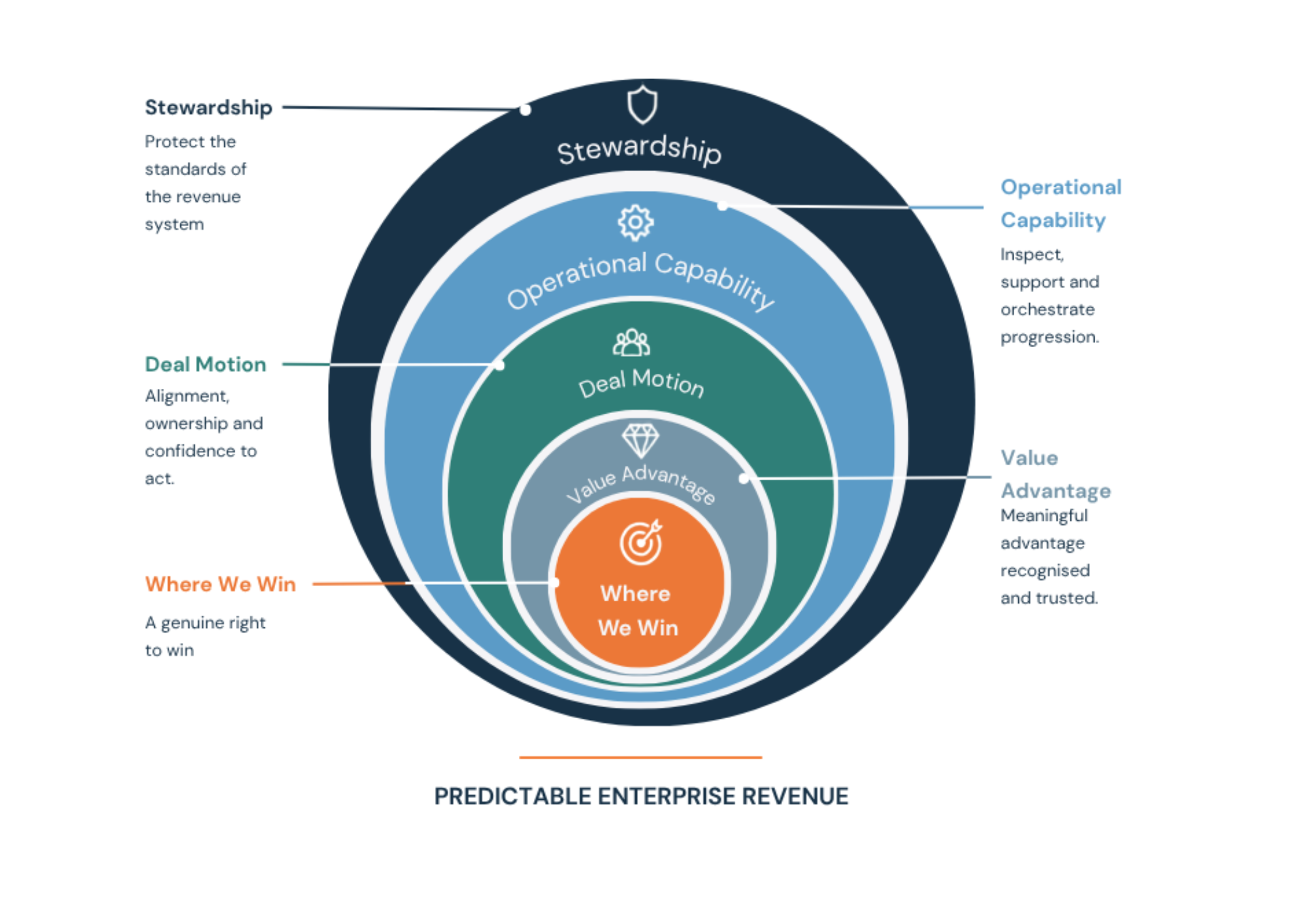
The Revenue Discipline Model brings together five connected disciplines that influence the quality, progression and predictability of enterprise revenue. It gives leadership a way to look beyond individual opportunities and understand the wider conditions shaping whether the organisation is pursuing the right business, creating value the customer recognises, supporting the customer decision effectively and maintaining the internal discipline required to sustain that way of working.
The five disciplines are Where We Win, Value Advantage, Deal Motion, Operational Capability and Stewardship. Together, they connect the organisation’s strategic market positioning with value recognised by the customer, the progress of the customer decision, and the leadership and capabilities required to support those conditions across opportunities.
Understanding the model
The disciplines should be understood as connected layers rather than sequential sales stages. An opportunity does not move from one discipline to the next; each provides a different but connected view of opportunity quality, customer value, customer decision progress, organisational support and leadership discipline. Together, they provide a broader view of the revenue system than any one discipline can provide on its own.
The purpose of the RDM is to help leadership understand what is really driving the opportunities in the pipeline and, through stronger evidence, build a clearer view of enterprise performance and greater confidence in the forecast.
It helps leaders examine whether the organisation is pursuing opportunities where it has a genuine right to win, whether customers recognise enough meaningful advantage to act, whether buying groups are developing the alignment, ownership and confidence required to make a decision, and whether the organisation can support those conditions consistently.
What the RDM does not replace
The RDM is not intended to replace a sales methodology, qualification framework, CRM structure or deal process. Those mechanisms remain important because they provide structure for sales execution.
The RDM provides a way to help leadership understand whether the conditions needed for repeatable enterprise performance are in place and where they need attention.
WHERE WE WIN
Where do you have a genuine right to win?
The Revenue Discipline Model starts with Where We Win, which defines the customers, situations and conditions where the organisation has a genuine right to win. It provides the foundation for deciding which opportunities deserve attention in the first place.
That matters for two reasons.
First, without clear focus on the conditions that make an opportunity winnable, the quality of what enters the pipeline weakens. Less of that pipeline converts into revenue, sales cycles lengthen and confidence in the forecast reduces.
Second, enterprise opportunities are expensive to pursue, consuming sales time, leadership attention and specialist support over long periods. Pursuing the wrong opportunities therefore carries both a revenue cost and a significant cost in wasted effort and capacity.
Where We Win goes beyond defining an ideal customer by industry, size or geography. It considers the wider conditions around the opportunity: the customer situation, the problem they are trying to solve, the reason for change and how strongly the organisation’s capabilities map to that need. It also considers the competitive environment: the strength of incumbent relationships, the organisation’s existing trust and access, and whether there is a realistic route to changing the status quo.
This means an organisation can have a strong proposition, differentiated capability and a solution well matched to the customer’s problem, yet still not have the wider conditions in place to win that particular opportunity. Winnability therefore depends on more than the strength of the proposition; it depends on how those conditions come together in this particular customer situation.
Where We Win creates a more disciplined basis for opportunity selection. It gives leadership a clearer way to distinguish between business that is merely possible and business where the organisation has a credible commercial position worth investing in.
VALUE ADVANTAGE
When your advantage matters to the customer.
Value Advantage focuses on whether the customer recognises an advantage that is meaningful to them and connects it to an outcome that matters.
A capability may be genuinely distinctive without creating meaningful advantage for a particular customer. Its value depends on the problem the customer is trying to solve, the outcome they are seeking and whether that advantage matters enough to shape what they decide to do. The customer also needs to believe the promised outcome can be delivered and that the solution can work in practice, including the realities of integration, implementation, adoption and change.
Taken together, these conditions are captured in the RDM definition of Value Advantage:
Meaningful advantage recognised and trusted by buyers in their own environment.
In practice, that means the advantage needs to be meaningful enough to matter, visible enough for the customer to recognise, credible enough to trust and viable enough for the customer to believe it can work in their business.
Where these conditions are weak, an opportunity can continue generating activity without becoming more likely to convert. The customer may continue engaging while still lacking a compelling reason to change or confidence that the promised outcome will be achieved. Value Advantage gives leadership a way to look beyond whether the proposition is strong on paper and examine whether customers are consistently recognising meaningful advantage they trust and can act on.
DEAL MOTION
How enterprise decisions build enough confidence to move forward.
Enterprise decisions develop across several people with different responsibilities, concerns and levels of influence. Each may be weighing different risks and looking for different evidence before they are comfortable supporting the same outcome. For the sales team, much of what shapes that decision happens inside the customer, making it difficult to understand whether the buying group is genuinely moving towards commitment or simply remaining engaged. Deal Motion focuses on how the buying group develops the alignment, ownership and confidence required to act.
An opportunity can therefore appear healthy from the seller’s perspective while remaining fragile inside the customer. One enthusiastic stakeholder may be driving the external conversation without having enough support internally. A technical team may be comfortable with the solution while concerns remain unresolved elsewhere. Unless those differences are understood, it is easy to mistake engagement with parts of the organisation for confidence across the buying group.
A useful way to examine Deal Motion is to start with the end in mind:
What needs to become true for this particular customer to confidently make the decision?
Those conditions will vary by opportunity, but they may include wider agreement on the business outcome, support from particular stakeholders, resolution of key risks, evidence that the solution will work, or greater confidence around implementation and adoption.
Progress then becomes visible through changes in the way the buying group behaves. The need for change becomes more widely understood, relevant stakeholders become involved for clear reasons, the desired outcome becomes more specific and internal ownership begins to strengthen.
Questions around commercial considerations, implementation, risk or adoption start to be worked through rather than deferred, while the people involved develop a clearer view of what needs to happen before a decision can be made.
For leadership, Deal Motion provides a way to inspect whether that confidence to act is actually developing. The important questions become less about the volume of activity and more about whether there is clear internal ownership for moving the decision forward, whether the right people are aligned around the problem and outcome, what risks still need to be resolved, and whether the buying group is becoming more capable of making the decision for itself.
When those conditions develop, the opportunity has more than momentum in the seller’s process; there is evidence that the customer’s decision is taking shape. Where those conditions are still developing, continued activity can make an opportunity appear further advanced than it really is, particularly where support across the buying group is limited or the ownership and alignment needed to move forward have not yet formed.
OPERATIONAL CAPABILITY
How the organisation supports real deal progress.
The salesperson leading an enterprise opportunity is naturally close to the deal. That closeness is necessary, but it can make it harder to step outside its momentum and judge what the evidence really supports.
Operational Capability is the organisation’s ability to consistently inspect, support and orchestrate enterprise decision progression. It creates the organisational discipline needed to challenge the current view of an opportunity, identify where wider support is required and bring the right people together around what the customer decision needs.
Regular deal reviews are an important part of that capability, but having a review cadence does not necessarily mean the right things are being inspected. Questions such as “What’s next?”, “When will it close?” and “Can we move it to commit?” may be useful, but on their own they mainly inspect the organisation’s sales process and forecast.
Stronger inspection looks at the customer decision itself: who is driving it internally, where alignment is weak, what risk remains unresolved and who inside the customer still needs to be involved.
Operational Capability creates the discipline to inspect and challenge the evidence behind the customer decision consistently.
Inspection should reveal where the opportunity requires wider organisational support. Where technical or security concerns affect the decision, technical specialists may need to work with the customer’s technical stakeholders, while executive involvement can help build credibility and alignment at a senior level. Product, Customer Success or other specialist expertise may be needed at different points to address specific customer questions, risks or concerns. Effective enterprise selling depends on that expertise being accessible without relying on the individual relationships or internal influence of the salesperson leading the opportunity.
Bringing the right people into an opportunity is only part of the requirement; they also need to work together effectively. Product, technical, delivery, adoption and customer-facing teams will have their own functional priorities, and supporting an enterprise opportunity has to sit alongside them. Coordinating that contribution effectively requires shared context, clear roles, open communication and a common understanding of what the customer is trying to achieve. Without that coordination, support can arrive too late, receive insufficient attention or become a collection of separate functional interactions rather than one coordinated customer experience.
Operational Capability therefore combines disciplined inspection with the ability to act on what that inspection reveals. The organisation needs the cadence to challenge the current view, the ability to recognise where additional support is required and the means to mobilise and coordinate the right people around the opportunity. Done consistently, those practices become part of the organisation’s enterprise capability rather than something dependent on individual judgement, informal influence or late intervention.
STEWARDSHIP
How leadership protects the revenue system.
When commercial pressure builds, organisations can gradually drift away from the standards they intended to follow. Qualification can widen, optimism can replace evidence, exceptions become more common and short-term pressure starts to influence which opportunities receive attention.
Over time, those behaviours weaken the connection between commercial execution and the organisation’s wider strategy: where it wants to compete, the customers it is best placed to serve and the value it wants to create in those markets.
Stewardship is the leadership discipline that protects those standards, keeps commercial execution aligned with strategy and ensures accountability and learning are maintained across the revenue system.
This translates into being clear about the standards leadership expects and reinforcing them through the way opportunities and forecasts are inspected. It also means maintaining alignment across the GTM organisation around the strategy: who the organisation is targeting, the value it is trying to create and how opportunities should be supported.
Where that alignment breaks down, Stewardship needs to address the underlying issue. If sales struggles to access technical support, product and commercial teams are working from different assumptions, or delivery and adoption expertise is consistently involved too late, leadership needs to resolve the priorities, roles or accountabilities behind those patterns rather than leave individual teams to work around them.
Stewardship also ensures that learning from the market is fed back into the wider revenue system. Patterns across wins, losses and stalled opportunities can show whether the organisation is creating the right conditions across the Revenue Discipline Model, and where those conditions need to be strengthened or changed. Those lessons should influence future decisions about targeting, positioning, messaging and how opportunities are supported.
This is how Stewardship helps the organisation operate as one revenue system.
Why the five disciplines have to work together
Enterprise revenue problems are rarely contained neatly within one part of the revenue system, and the issue that becomes visible to leadership is not always where the underlying problem began. A stalled opportunity, missed forecast or weak conversion rate may therefore be the result of something that started much earlier or sits elsewhere in the model.
Weak conversion, for example, may look like a problem with deal execution, but the cause may sit much earlier. The organisation may be pursuing opportunities where its value is not strong enough, where an incumbent competitor is too deeply embedded, or where the customer does not have a sufficiently important reason to change. In those situations, more activity inside the deal is unlikely to solve the real problem.
The disciplines also depend on one another. Being well positioned to win has limited commercial value if the customer does not recognise enough advantage to act, while recognised value will not convert if the buying group cannot develop the alignment, ownership and confidence required to make the decision.
The organisation then needs the capability and leadership discipline to inspect, support and protect those conditions consistently, keeping them aligned with the organisation’s wider strategy. Learning from wins, losses and stalled opportunities should then feed back into how the organisation competes and executes.
Looking across the five disciplines gives leadership a stronger basis for deciding what actually needs attention. Rather than treating every missed forecast, stalled opportunity or conversion problem as the same type of issue, the organisation can trace what is happening across the revenue system and respond to the underlying cause rather than only the outcome that becomes visible.
What predictable enterprise revenue really means
Predictable enterprise revenue does not mean removing uncertainty from complex buying decisions or assuming that every opportunity will close when expected. Enterprise deals will always carry risk, competing priorities, internal politics and factors outside the seller’s control. The aim is to give leadership a clearer and more credible understanding of what is likely to happen.
That creates a different standard for forecasting.
Rather than treating the forecast as a collection of dates, probabilities and seller opinions, leadership can build confidence around the evidence supporting each opportunity. A deal may still move, slow down or be lost, but the organisation should be able to explain what changed, why confidence increased or reduced, and what that means for the wider revenue outlook.
Within the Revenue Discipline Model, predictable enterprise revenue therefore means that leadership can assess and explain future revenue with greater confidence because opportunity quality, decision progression and risk are understood through credible evidence. The more consistently those conditions can be seen and understood across the pipeline, the less dependent the organisation becomes on optimism, intuition or late-quarter intervention.
Five questions for revenue leaders
For leaders, this creates a practical way to examine the health of the wider revenue system. The questions are straightforward:
Where We Win
Are we pursuing opportunities where we are genuinely positioned to win;
Value Advantage
Do customers recognise a meaningful advantage they trust;
Deal Motion
Is the buying group developing the alignment, ownership and confidence required to act;
Operational Capability
Can the organisation consistently inspect that progress and mobilise the support required;
Stewardship
Is leadership protecting the standards that keep those disciplines working together?
Those questions do not provide certainty, but they provide a stronger basis for judgement. They help leadership understand where confidence in the pipeline is supported by evidence, where it is being assumed, and where the organisation needs to focus if enterprise revenue is to become more consistent and more explainable over time.
Where to start with the Revenue Discipline Model
The Revenue Discipline Model is most useful when it gives leadership a clearer way to examine the revenue system they already have. Rather than beginning with a new process or another layer of qualification, start by examining a small number of important opportunities through the five disciplines and asking where the evidence is strong, where it is incomplete and what is actually shaping the outcome before deciding what needs to change.
As patterns become clearer across multiple opportunities, leadership can see whether the same weaknesses are recurring and which part of the Revenue Discipline Model they relate to. This moves the conversation beyond individual deals and towards where leadership should investigate and strengthen the wider revenue system.
Predictability will never mean knowing exactly what will happen. It means being able to explain, with credible evidence, why particular opportunities deserve confidence, where that confidence should be lower and what needs attention across the revenue system.
That is a stronger foundation for building enterprise revenue that becomes more consistent, more explainable and, over time, more predictable.
Download the complete guide
Read the complete Revenue Discipline Model as a designed guide, including the five disciplines, leadership questions and a practical starting point for reviewing enterprise opportunities.
Continue the conversation
If the Revenue Discipline Model has prompted you to look differently at the opportunities in your pipeline, an introductory conversation is a useful place to continue.
